

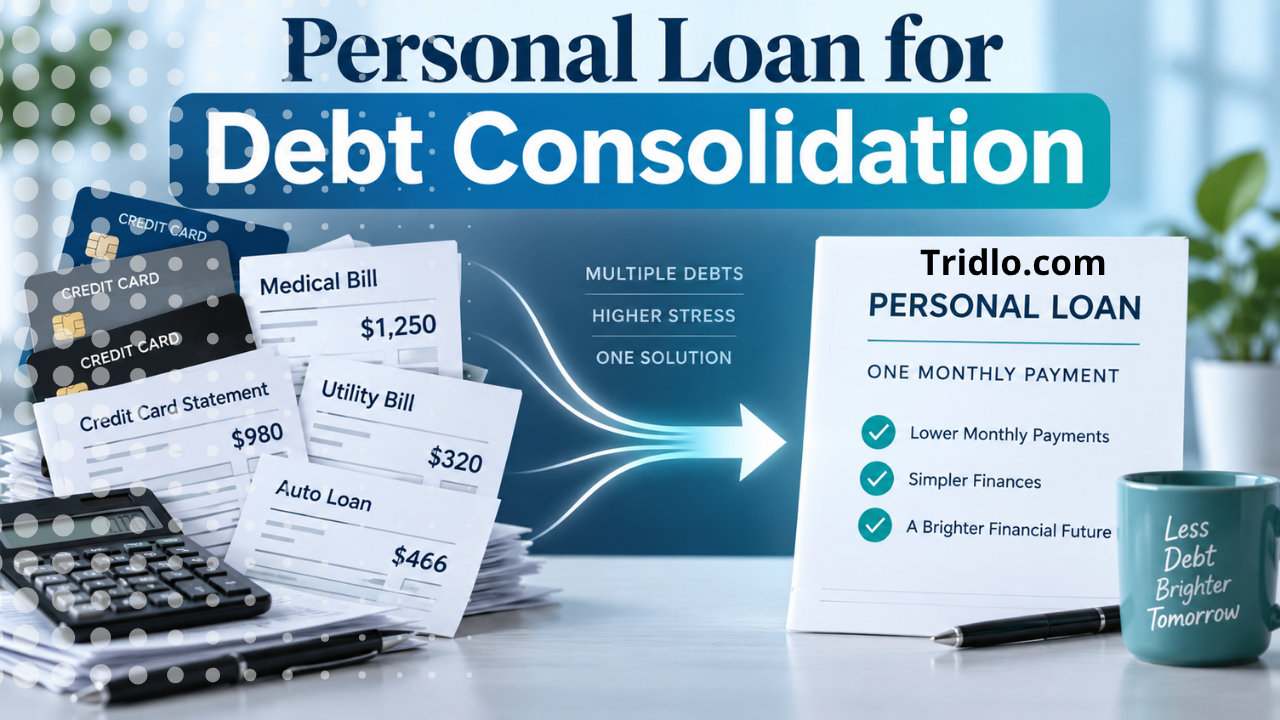
Managing several high-interest balances can make it difficult to see when your debt will actually be paid off. A personal loan for debt consolidation can simplify repayment by combining eligible balances into one installment loan with a fixed monthly payment and a defined payoff date.
The potential benefit is not just convenience. If the new loan has a lower overall borrowing cost than your existing debts, consolidation may reduce the amount of interest you pay. But the smallest monthly payment is not automatically the cheapest option. APR, origination fees, repayment term, funding speed, direct-pay features, and lender requirements all affect the real cost.
Current 2026 data shows why comparison matters. The Federal Reserve’s August 2026 G.19 release reported an average 11.86% rate on 24-month personal loans at commercial banks, while credit card accounts that were assessed interest averaged 22.15%. Those are broad market figures rather than guaranteed offers, but they illustrate why a well-priced personal loan can be worth comparing with high-interest revolving debt.
This guide explains how consolidation loans work, reviews current lender terms verified in 2026, shows how rates vary by credit profile, and outlines the steps to compare a personal loan to consolidate credit card debt without focusing only on the advertised rate.
Key Takeaways
- A debt consolidation personal loan can replace multiple eligible balances with one fixed monthly payment.
- APR matters more than the interest rate alone because it reflects the cost of many lender fees.
- Shorter repayment terms usually raise the monthly payment but reduce lifetime interest.
- Origination fees can reduce the cash you actually receive, so compare net proceeds before accepting an offer.
- Direct creditor payment can simplify the transition and reduce the risk of leaving an account partially unpaid.
- Prequalification can help you compare potential rates without a hard inquiry at many lenders.
- A 0% balance transfer may be cheaper when you can repay the balance before the promotional period ends.
What Is a Personal Loan for Debt Consolidation?
A debt consolidation personal loan is an installment loan used to pay off multiple existing debts, commonly credit card balances or other unsecured obligations. Instead of managing several due dates and interest rates, you make one payment toward the new loan.
Most personal loans used for consolidation have a fixed rate, a fixed monthly payment, and a set repayment period. That structure can make budgeting easier because you know what is due each month and when the loan is scheduled to end.
The goal should not be to move debt from one account to another. Consolidation works best when the new arrangement improves your repayment position through a lower APR, lower fees, a manageable term, a clearer payoff schedule, or a combination of those benefits.
From Several Credit Cards to One Fixed Payment
If you carry balances on several credit cards, each account may have a different APR, minimum payment, and due date. A personal loan can be used to pay those accounts, leaving you with one installment payment.
Unlike revolving credit, an installment loan has a defined term. Every scheduled payment moves the balance toward a set payoff date. That can be useful for borrowers who want more structure than minimum credit card payments provide.
Direct Creditor Payments vs. Receiving the Funds Yourself
Some lenders offer direct pay, which means the lender sends some or all of the loan proceeds directly to the creditors you are consolidating. This can reduce administrative work and lower the chance of missing an account during the payoff process.
Other lenders deposit the money into your bank account. If you manage the payoffs yourself, request current payoff amounts, account for any trailing interest, and pay each creditor promptly. Continue monitoring every account until it shows a zero balance.
Why Fixed Rates Matter
A fixed rate personal loan for debt consolidation keeps the loan’s interest rate and scheduled payment predictable. Credit card rates can change, while a fixed-rate installment loan gives you a more stable repayment plan.
Predictability does not automatically mean a loan is cheaper. Always compare the full APR, fees, term, and total repayment amount before deciding.
Personal Loan Rates by Credit Score in 2026
Credit quality is one of the strongest factors affecting the APR you may receive. LendingTree marketplace data for the second quarter of 2026 shows a wide difference between borrowers with excellent credit and those with fair or poor credit.
| Credit Score | Credit Tier | Average APR |
|---|---|---|
| 800+ | Excellent | 15.34% |
| 740-799 | Very Good | 17.46% |
| 670-739 | Good | 22.70% |
| 580-669 | Fair | 27.52% |
| Below 580 | Poor | 30.51% |
These figures reflect LendingTree user offers for typical loan amounts of $5,000 to $54,999 and repayment terms of 36 to 83 months in Q2 2026. They are market averages, not guaranteed rates.
Your actual APR can also depend on income, debt-to-income ratio, credit utilization, account history, recent inquiries, loan amount, repayment term, state rules, and the lender’s underwriting model.
Best Personal Loans for Debt Consolidation in 2026
There is no single lender that is best for every borrower. The best personal loan for debt consolidation is the offer that gives you the strongest combination of APR, fees, repayment terms, sufficient loan amount, manageable monthly payment, and realistic approval requirements.
The table below summarizes current publicly disclosed terms verified through lender websites and current disclosures in September 2026. Rates and terms can change without notice, and the lowest advertised APRs are generally reserved for highly qualified applicants.
| Lender | Current APR / Rate Disclosure | Loan Amount | Terms | Origination Fee |
|---|---|---|---|---|
| Upgrade | 7.74%-35.99% APR | $1,000-$50,000 | 24-84 months | 1.85%-9.99% |
| Upstart | 6.3%-35.99% APR | $1,000-$75,000 | 36 or 60 months | 0%-12% |
| Best Egg | 6.99%-35.99% APR | $2,000-$50,000 | 36-60 months | 0.99%-9.99% |
| LightStream | Rates vary; maximum APR 25.39% | $5,000-$100,000 | 24-84 months for debt consolidation | None |
| Discover | 6.99%-24.99% APR | $2,500-$40,000 | 36-84 months | None |
| Happy Money | 8.95%-35.99% APR | $5,000-$50,000 | 24-60 months | 2%-12% |
| PenFed Credit Union | Live APR quoted dynamically | Up to $50,000 | Up to 60 months | None |
| Achieve | 6.25%-35.99% APR | $5,000-$50,000 | 24-60 months | 1.99%-9.99% |
| SoFi | 6.99%-35.49% APR | $5,000-$100,000 | Generally 24-84 months | 0%-7% |
| Prosper | 8.99%-35.99% APR | Up to $50,000 | 24-72 months | 1%-9.99% |
Upgrade: Broad Options and Direct-Pay Discounts
Upgrade currently offers personal loans from $1,000 to $50,000 with APRs of 7.74% to 35.99% and repayment terms from 24 to 84 months. Origination fees range from 1.85% to 9.99% and are deducted from the loan proceeds.
Qualified borrowers may receive lower pricing by setting up autopay, using part of the loan to pay existing debt directly, or choosing certain secured options. Upgrade says funds are generally sent within one business day after required verifications are cleared, although payments sent directly to third-party creditors can take longer.
Best for: Borrowers who want flexible term choices and direct-pay options, including applicants who may not fit the strictest prime-lender profiles.
Upstart: Flexible Underwriting for a Wider Range of Profiles
Upstart’s marketplace currently lists unsecured personal loan APRs from 6.3% to 35.99%, with loan amounts from $1,000 to $75,000 and fixed terms of three or five years. Upstart says origination fees can range from 0% to 12% and are deducted from the principal when applicable.
Upstart considers more than a traditional credit score in its underwriting process, including information such as income, employment, and other application details. Checking a rate uses a soft inquiry, while moving forward with a full application generally requires a hard inquiry.
Best for: Borrowers who want to explore offers through a marketplace model and may benefit from underwriting that looks beyond credit score alone.
Best Egg: Competitive Options for Strong Credit
Best Egg currently publishes APRs from 6.99% to 35.99%, loan amounts from $2,000 to $50,000, and terms from 36 to 60 months. Origination fees range from 0.99% to 9.99%. For loan terms of four years or longer, the origination fee is at least 4.99%.
Best Egg states that funds can generally arrive within one to three business days after successful verification, with about half of customers receiving money the next day. Products are not currently available to residents of Iowa, Vermont, West Virginia, Washington, D.C., or U.S. territories.
Best for: Borrowers with solid credit and income who want a straightforward fixed-rate loan and are comfortable comparing an origination fee against no-fee alternatives.
LightStream: No Fees and a Rate Beat Program
LightStream by Truist offers unsecured fixed-rate loans from $5,000 to $100,000. For debt consolidation, repayment terms run from 24 to 84 months. LightStream charges no origination fee or prepayment penalty.
The lender publishes a maximum APR of 25.39%, while the actual rate depends on purpose, amount, term, and credit profile. Advertised rates include an AutoPay discount; rates without AutoPay are 0.50 percentage points higher. LightStream also offers a Rate Beat Program that may beat a qualifying competing unsecured loan by 0.10 percentage points.
LightStream is geared toward borrowers with strong credit, and it does not offer the same soft-pull prequalification experience many online lenders provide.
Best for: Good-to-excellent credit borrowers who value a no-fee structure, larger loan amounts, and competitive fixed-rate pricing.
Discover: No Fees and Direct Creditor Payment
Discover Personal Loans currently offers $2,500 to $40,000 with APRs from 6.99% to 24.99% and repayment terms of 36 to 84 months. Discover advertises no fees of any kind and says funds may be sent as early as the next business day after acceptance.
Borrowers can use direct creditor payment for many eligible debts. However, Discover notes that its personal loan cannot be used to directly pay certain Capital One accounts, including Discover or Capital One credit cards, or certain secured and education-related debts.
Best for: Borrowers who want transparent no-fee pricing and the convenience of creditor direct pay.
Happy Money: Focused on Credit Card Payoff
Happy Money’s lending partners currently offer fixed-rate loans from $5,000 to $50,000 with APRs from 8.95% to 35.99% and terms from 24 to 60 months. The published APR includes an origination fee of 2% to 12%.
The advertised rates reflect an Autopay discount. Happy Money currently states that its loans are not offered in Iowa. Its Payoff Loan is specifically positioned around paying down credit card debt.
Best for: Borrowers whose main goal is credit card consolidation and who want a product designed around a fixed payoff plan.
PenFed Credit Union: No Origination Fee and Up to Five Years
PenFed offers unsecured personal loans up to $50,000 with terms up to 60 months. It advertises no origination fee, no early payoff fee, and no balance transfer fee. Borrowers can check estimated rates using a soft inquiry, and a 0.25-percentage-point AutoPay discount is available when set up before funding.
PenFed’s current website displays the live APR dynamically, so the exact range should be checked immediately before applying rather than relying on a static number copied into an article.
Best for: Borrowers who want a credit union option with no origination fee and a relatively simple fee structure.
Achieve: Direct-Pay Discounts and Customizable Terms
Achieve currently offers personal loans from $5,000 to $50,000, APRs from 6.25% to 35.99%, and repayment terms from 24 to 60 months. Origination fees range from 1.99% to 9.99%.
Borrowers may qualify for lower rates by using at least 85% of the proceeds to pay eligible existing debts directly, applying with a qualifying co-borrower, or providing proof of qualifying retirement savings. Achieve says funding is typically sent within 24 to 72 hours, although timing varies.
Best for: Borrowers who can use direct creditor payoff or other qualifying factors to pursue a rate discount.
SoFi: Large Loan Amounts and Multiple Rate Discounts
SoFi currently publishes fixed personal loan APRs from 6.99% to 35.49%, with loan amounts from $5,000 to $100,000. Its APR reflects an origination fee ranging from 0% to 7%, which is deducted from proceeds when applicable.
SoFi offers a 0.25% AutoPay rate reduction and additional qualifying discounts through membership or direct-pay programs. The company also advertises same-day funding for many approved borrowers who complete required steps by its stated cutoff time.
Best for: Borrowers who need a larger consolidation amount and want to compare multiple discount options.
Prosper: Marketplace Lending With Terms Up to Six Years
Prosper currently lists personal loan APRs from 8.99% to 35.99%, loan amounts up to $50,000, and terms from two to six years. Origination fees range from 1% to 9.99% and are deducted from loan proceeds.
Prosper operates as a lending marketplace, and personal loans are made by WebBank. The company says eligible borrowers may receive funds as soon as one business day after acceptance, verification, and final approval, although marketplace funding requirements can affect timing.
Best for: Borrowers who want another marketplace option and can compare the fee-adjusted cost with banks, credit unions, and direct online lenders.
How to Compare Personal Loan Offers
Finding a low interest personal loan for debt consolidation requires more than sorting lenders by the lowest advertised APR. Your personal quote is what matters.
Compare APR, Not Just the Interest Rate
APR is designed to reflect the yearly cost of credit and includes many loan fees. If two lenders advertise similar interest rates but one charges a large origination fee, the APR can reveal the difference more clearly.
Always compare the APR shown in your actual offer rather than assuming you will qualify for a lender’s minimum rate.
Calculate Net Proceeds After the Origination Fee
An origination fee can reduce the amount of money deposited into your account. If you need exactly $20,000 to clear several balances, a $20,000 loan with a fee deducted from proceeds may leave you short.
A simple check is:
Loan amount – origination fee = approximate net proceeds
Then compare those proceeds with the payoff amounts you actually need.
Choose the Shortest Affordable Term
Longer terms reduce the required monthly payment but usually increase total interest. Shorter terms do the opposite: the payment is higher, but the debt is paid off sooner and lifetime interest is generally lower.
The strongest term is usually the shortest one your budget can handle comfortably without putting essential expenses or emergency savings at risk.
Compare Funding Speed
Funding speed matters when your existing balances continue to accrue interest. Some lenders can send funds the same day or next business day after final approval, while creditor direct-pay transfers may take longer.
Do not stop making required payments on existing accounts until you confirm that every payoff has posted.
Look for Discounts That Actually Reduce Total Cost
Common lender discounts include AutoPay, direct creditor payment, membership benefits, and direct deposit. A discount can improve the offer, but compare the final APR and total repayment amount rather than treating the discount percentage by itself as savings.
Use Prequalification Before Full Applications When Available
Many lenders let you check potential rates with a soft inquiry. This can help you compare several offers without immediately adding multiple hard inquiries to your credit report.
A full application generally requires a hard credit inquiry, which may cause a small temporary change in your credit score.
Can a Personal Loan to Pay Off High-Interest Debt Save Money?
A personal loan to pay off high interest debt can save money when the new loan’s total cost is lower than the cost of continuing to carry the existing balances.
The Federal Reserve’s latest 2026 figures provide useful context: the average commercial-bank rate on 24-month personal loans was 11.86%, while credit card accounts that were actually assessed interest averaged 22.15%. Individual personal loan offers may be far above or below those figures, but the gap shows why comparison can matter.
When you run your own numbers, compare:
- The APR on each debt you plan to pay off
- The APR on the proposed consolidation loan
- Any origination or transfer fee
- The monthly payment
- The repayment term
- Total interest and total repayment
Do not assume a lower monthly payment means you are saving money. Extending repayment over several additional years can reduce the monthly bill while increasing the amount paid overall.
How to Qualify for a Debt Consolidation Personal Loan
Approval depends on your overall financial profile. Different lenders use different underwriting models, but several factors appear repeatedly.
Credit Score and Credit History
A stronger credit profile generally gives you access to more lenders and lower rates. However, some online marketplaces evaluate additional information and may serve borrowers who do not meet prime-bank standards.
Do not focus on a single minimum score as a guarantee. Lenders also evaluate the quality and depth of your credit history, recent activity, and payment behavior.
Debt-to-Income Ratio
Your debt-to-income ratio compares monthly debt obligations with monthly income. A lower ratio generally gives a lender more confidence that your budget can handle another required payment.
If your DTI is high, reducing balances before applying may improve both approval odds and the terms offered.
Credit Utilization
Credit utilization measures how much of your available revolving credit you are using. Paying card balances down before applying can improve utilization and may strengthen your credit profile.
After consolidation, avoiding new balances is important. Otherwise, you can end up with both the new installment loan and renewed credit card debt.
Income and Documentation
Lenders may request documents such as:
- Government-issued identification
- Recent pay stubs
- W-2 forms or tax documents
- Bank statements
- Employment information
- Statements for the debts you plan to consolidate
Preparing accurate documents before applying can reduce verification delays.
Unsecured vs. Secured Personal Loans for Debt Consolidation
Most personal loans used for consolidation are unsecured, meaning they do not require you to pledge a house, vehicle, or other asset as collateral.
An unsecured personal loan for debt consolidation relies more heavily on your credit history, income, DTI, and overall ability to repay. Some lenders may also offer secured alternatives, which can sometimes produce different pricing.
The trade-off is risk. If you secure a loan with an asset and then default, the lender may have the right to take the collateral. A lower rate is not automatically worth putting an important asset at risk.
How Debt Consolidation Can Affect Your Credit
Debt consolidation can affect your credit in several ways, and the direction is not always immediate.
Possible Short-Term Effects
A full loan application usually creates a hard inquiry. Opening a new account can also reduce the average age of your accounts. These factors may cause a small temporary score decline.
Potential Longer-Term Benefits
Paying down credit card balances can reduce revolving utilization, which may help your credit profile. Consistent on-time payments on the new loan can also strengthen payment history over time.
To protect your progress:
- Set up automatic payments or reliable reminders.
- Do not miss payments while creditor transfers are processing.
- Avoid opening unnecessary new accounts.
- Keep paid-off cards from rebuilding large balances.
- Monitor your credit reports for payoff and balance updates.
Personal Loan vs. 0% Balance Transfer Credit Card
A personal loan is not always the cheapest consolidation tool. A 0% introductory balance transfer card can be attractive if you qualify and can repay the balance within the promotional period.
When a Balance Transfer May Be Better
- You qualify for a long 0% promotional APR period.
- You can repay the full transferred balance before the promotion expires.
- The transfer fee is lower than the cost of a personal loan.
- You can avoid adding new charges to the card.
When a Personal Loan May Be Better
- You need more time than the promotional period allows.
- You want a fixed monthly payment and defined payoff date.
- Your balance is too large for the available transfer limit.
- You qualify for a competitive fixed-rate loan.
- You prefer an installment structure that makes reborrowing harder.
Compare the balance transfer fee with the loan’s origination fee and total interest. The cheapest option is the one with the lower total cost that you can realistically repay on schedule.
Safety, Lender Transparency, and What to Verify
Debt consolidation is a financial decision, so lender transparency matters. Before accepting an offer, confirm who is making the loan, who will service it, and which fees are included.
Many financial technology platforms work with partner banks. Others, such as credit unions, have membership structures. Review the disclosures rather than relying on a comparison page alone.
Verify the following before signing:
- Final APR and interest rate
- Origination fee and net proceeds
- Repayment term
- Monthly payment
- Late-fee policy
- Prepayment rules
- Direct-pay limitations
- Funding timeline
- State restrictions
- Originating bank or credit union
- Servicer and customer support channels
FDIC or NCUA insurance protects eligible deposits at insured institutions; it does not insure the balance of a personal loan.
How to Apply for a Personal Loan for Credit Card Debt Consolidation
1. Add Up the Debts You Want to Consolidate
Collect current statements and list each balance, APR, minimum payment, and payoff amount. Decide which debts you actually want the new loan to cover.
2. Review Your Credit and Monthly Budget
Check your credit reports, estimate your DTI, and decide how much monthly payment your budget can realistically support.
3. Check Prequalified Offers
Where available, use soft-pull rate checks to compare lenders before completing a full application.
4. Compare APR, Fees, and Total Repayment
Do not select a loan solely because its monthly payment looks attractive. Compare the complete cost and confirm how much money you will receive after fees.
5. Choose a Repayment Term You Can Sustain
Use the shortest affordable term that leaves enough room in your budget for essential expenses and emergencies.
6. Prepare Verification Documents
Have identification, income documentation, bank information, and creditor statements ready to reduce delays.
7. Pay Off the Existing Balances
If the lender offers direct pay, confirm which accounts will be paid and how long the transfers may take. If the funds are deposited into your account, pay the creditors promptly.
8. Confirm Every Account Reaches Zero
Trailing interest and pending transactions can leave small balances. Keep monitoring the old accounts until each payoff is complete.
9. Automate the New Payment
Autopay can help protect your payment history and may qualify you for a lender discount.
10. Avoid Rebuilding Card Balances
Consolidation is most effective when the paid-off balances stay paid off. New card spending can erase the benefit of the new repayment plan.
Common Debt Consolidation Mistakes to Avoid
- Choosing a loan based only on the minimum advertised rate
- Ignoring origination fees
- Borrowing more than you need
- Selecting an unnecessarily long term just to reduce the monthly payment
- Failing to check net proceeds after fees
- Stopping card payments before creditor transfers have posted
- Forgetting trailing interest
- Applying with too many lenders through hard inquiries at once
- Closing useful old accounts without considering the credit impact
- Running credit card balances back up after consolidation
A debt consolidation loan should improve your repayment position. If it only moves the debt while increasing fees or extending repayment far into the future, it may not be the right solution.
Frequently Asked Questions
What is a personal loan for debt consolidation?
A personal loan for debt consolidation is an installment loan used to pay off multiple eligible debts, such as credit card balances. You then make one fixed monthly payment toward the new loan instead of managing several separate payments.
Can a personal loan reduce the cost of credit card debt?
It can if the new loan’s APR, fees, and total repayment cost are lower than the cost of continuing to carry your existing balances. Compare total borrowing cost rather than focusing only on the monthly payment.
What credit score do I need for a debt consolidation loan?
There is no universal minimum credit score. Requirements vary by lender, and approval also depends on factors such as income, debt-to-income ratio, credit history, loan amount, and recent credit activity.
Does prequalifying for a personal loan hurt my credit?
Many lenders use a soft credit inquiry when you check your rate or prequalify, which generally does not affect your credit score. A full application usually involves a hard credit inquiry that may temporarily affect your score.
Can debt consolidation lower my monthly payment?
Yes. A longer repayment term can reduce the required monthly payment, but it may increase the total interest paid. A shorter term usually costs less overall but requires a higher monthly payment.
What is a direct-pay debt consolidation loan?
With direct creditor payment, the lender sends some or all of the loan proceeds directly to the creditors you want to pay off. This can simplify the consolidation process and reduce the risk of leaving an account unpaid.
How fast can a personal loan for debt consolidation be funded?
Funding speed varies by lender and verification requirements. Some lenders can send funds as soon as the same or next business day, while direct payments to creditors or marketplace-based loans may take longer.
Is a 0% balance transfer better than a debt consolidation loan?
A 0% balance transfer may be cheaper if you qualify and can repay the full balance before the promotional period ends. A fixed-rate personal loan may be more appropriate when you need a longer repayment period or want predictable monthly payments.
Conclusion
A personal loan for debt consolidation can turn several high-interest balances into one predictable payment and a defined payoff schedule. The best result comes from comparing your real offers carefully rather than choosing the lender with the lowest headline rate.
Use prequalification where available, compare APR and fees, check net proceeds, and choose the shortest repayment term your budget can comfortably handle. Features such as no origination fees, direct creditor payment, and AutoPay discounts can make one offer more useful than another, but total repayment cost should remain the deciding factor.
After the old balances are paid, confirm every account reaches zero and avoid rebuilding debt. That is what turns consolidation from a temporary transfer of balances into a practical repayment strategy.
Sources and 2026 Data Verification
The market benchmarks and lender terms in this article were checked against current public data and official product disclosures available on September 6, 2026. Before applying, confirm the live terms directly with the lender.
- Federal Reserve Consumer Credit (G.19), August 7, 2026
- LendingTree Q2 2026 Personal Loan Marketplace Data
- Upgrade Personal Loans
- Upstart Personal Loans
- Best Egg Personal Loans
- LightStream Debt Consolidation Loans
- Discover Personal Loans
- Happy Money
- PenFed Personal Loans
- Achieve Personal Loans
- SoFi Personal Loans
- Prosper Personal Loans
Financial Disclaimer: This article is for general educational and informational purposes only and does not constitute financial, legal, tax, or credit advice. Loan rates, fees, eligibility requirements, and product availability can change at any time and may vary by borrower and state. Review the lender’s current disclosures and your final loan agreement before accepting any offer.
Last updated: September 6, 2026. Market figures and lender terms in this guide were checked against current 2026 data and lender disclosures. Rates, fees, eligibility, and availability can change.


