

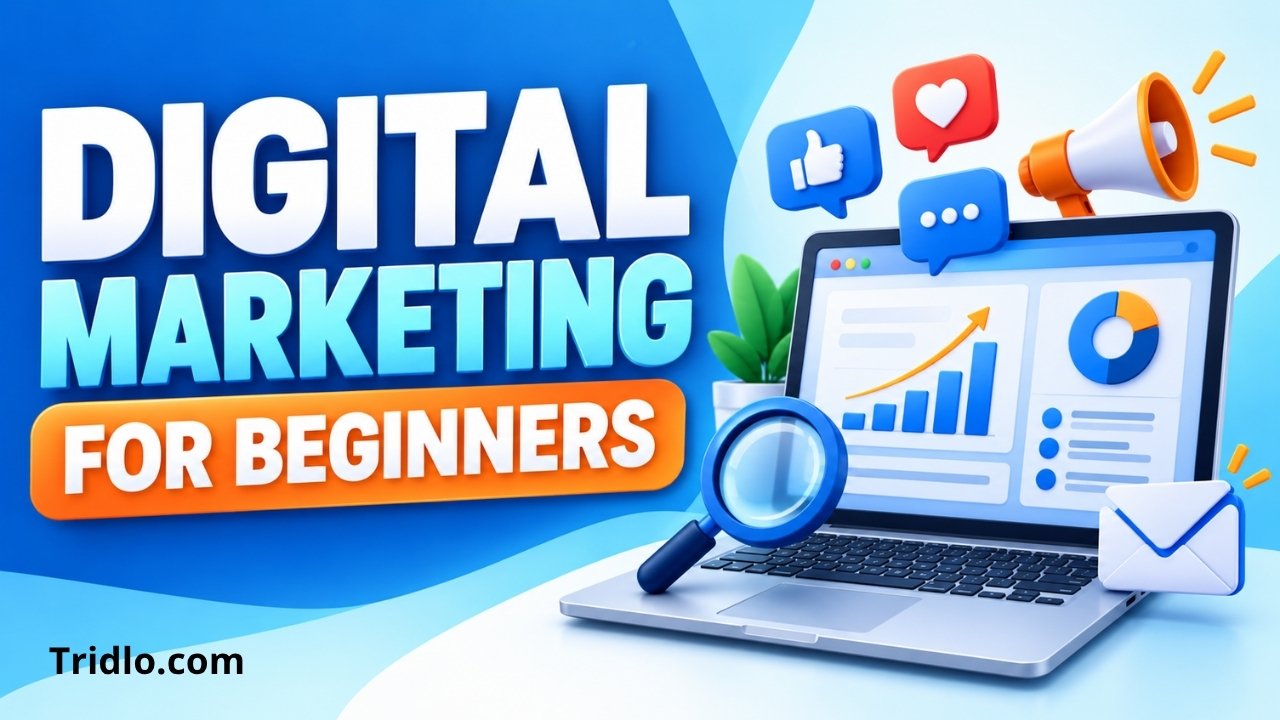
Learning digital marketing for beginners is easier when you start with a real task: help the right person discover an offer and take the next step. You do not need to master every platform before you begin. You need a clear audience, something useful to share, and a way to tell whether your work is producing results.
This guide explains the main online marketing channels, how to choose your first one, and how to build a manageable campaign. You will also learn what to measure, where to spend cautiously, and which mistakes can waste your early efforts.
What Is Digital Marketing?
Digital marketing means using online channels to reach potential customers, communicate value, and encourage actions such as purchases, inquiries, or newsletter subscriptions. It includes search engine optimization, content marketing, social media, email, paid advertising, and partnerships.
These activities serve different purposes. A helpful article can introduce your business. A product demonstration can answer a buyer’s concern. An email can bring an interested reader back when they are ready to act.
Digital marketing can support a local service business, an online store, a freelance practice, or a content website. The right approach depends on the customer and the decision they need to make.
How Online Marketing Works
A useful starting point is the customer journey. People usually need to discover you, understand your offer, and develop enough confidence to take action. After a purchase, good communication can help them return.
- Awareness: Someone finds your video, article, social post, or ad.
- Consideration: They review your services, examples, pricing, or product details.
- Conversion: They complete a valuable action, such as booking an appointment.
- Retention: You help existing customers get value and give them reasons to return.
For example, imagine a small home-organizing business. A visitor discovers a closet makeover video, opens a page explaining the service, and requests a consultation. A follow-up message answers their remaining questions. Each piece of marketing has a specific job.
Real journeys are rarely this tidy. Someone may visit several times or move between devices. Still, the model helps you connect your content to a business outcome.
The Main Digital Marketing Channels
Search Engine Optimization
Search engine optimization, or SEO, helps search engines understand your pages and helps people find relevant information. Start by answering a specific question clearly, using descriptive titles and headings, and linking related pages. Make your content easy to read and navigate.
You do not need to repeat a keyword in every paragraph. Google’s SEO Starter Guide emphasizes useful content and natural writing, and explains that improvements do not guarantee rankings. SEO changes can also take time to show an effect.
Choose SEO when people already search for problems your business solves and you can maintain useful pages over time. It is less suitable as your only method for generating immediate demand.
Content Marketing
Content marketing uses helpful material to attract and educate an audience. Blog posts, tutorials, videos, buying guides, and downloadable checklists are common formats.
Begin with questions customers ask before making a decision. For the home-organizing business, useful topics could include preparing for an appointment, choosing storage for a small closet, or understanding what the service includes.
Content is an asset you create; search, social media, and email are ways to distribute it. Publishing without a distribution plan leaves too much to chance.
Social Media Marketing
Social media can help people discover your work, ask questions, and see how you approach a problem. Start with one platform where your intended audience appears active and where you can produce a suitable format consistently.
A visual service might begin with short demonstrations. A professional service might focus on detailed explanations and industry discussions. Treat these as starting hypotheses and check how actual prospects respond.
The trade-off is dependence on a platform you do not control. A popular post may create attention without producing inquiries, so provide a relevant next step.
Email Marketing
Email marketing helps you stay in touch with people who have asked to hear from you. Offer a clear reason to subscribe, such as a useful checklist or a newsletter that solves a recurring problem.
A simple welcome sequence can deliver the promised resource, explain how to use it, and introduce an appropriate service or product. Keep each message focused on one main purpose.
Build your own permission-based list, explain what subscribers will receive, and make leaving easy. Email is useful for follow-up, but it does not remove the need to attract new people in the first place.
Paid Advertising
Paid advertising buys distribution through search engines, social platforms, or other websites. Search ads can reach people actively looking for something. Social ads can introduce an offer while people browse.
Pay-per-click, or PPC, describes a pricing model where you pay for clicks. Other campaigns may charge based on impressions or use different billing models.
Ads can generate traffic quickly, but profitable results are not automatic. Start only when you have a clear offer, a working destination page, measurement, and a spending limit. Paying to send visitors to a confusing page makes the problem more expensive.
Affiliate and Creator Partnerships
Affiliate marketing compensates partners for tracked outcomes such as sales. Creator partnerships may instead involve a fee, a gifted product, or another arrangement.
Audience relevance matters more than a large follower count. A small creator whose audience has the problem you solve may be a better fit than a broad entertainment account.
For U.S. audiences, material relationships that could affect an endorsement’s credibility should be clearly disclosed. Payment and free products can create these relationships. Review the FTC’s endorsement guidance when planning sponsored recommendations or affiliate content.
Which Marketing Channel Should You Start With?
Choose based on customer behavior, your available time, and the kind of content you can produce well. The following options are starting points to test.
| Your situation | Starting approach | Main trade-off |
|---|---|---|
| Customers search for your service | SEO and focused service pages | Visibility takes time to develop |
| Your offer benefits from demonstrations | Video and one social platform | Requires ongoing production |
| You have interested subscribers | Email follow-up | Depends on list quality and relevance |
| You have a clear offer and a test budget | A narrowly focused ad campaign | Spending may not produce profitable sales |
| You explain complex buying decisions | Educational content distributed through search or social | Needs subject knowledge and maintenance |
If you are starting from zero, choose one discovery channel and one destination for interested visitors. Add more channels after you understand what your first campaign is teaching you.
Digital Marketing for Beginners Step by Step
1. Define One Audience and One Problem
“Anyone who wants to get organized” is difficult to address. “Busy apartment renters struggling with limited closet space” gives you a clearer problem and more useful content ideas.
Read customer questions, speak with potential buyers, and examine the concerns that recur in relevant discussions. Look for what people need, what they have already tried, and what makes them hesitate.
2. Set a Measurable Goal
Choose an outcome that matters to your business. Examples include qualified consultation requests, completed purchases, or subscriptions from readers interested in your topic.
A first campaign could aim to generate five qualified inquiries in a month. That is an illustrative target, not a benchmark or a promised result. Adjust your goal to your audience, capacity, and starting point.
3. Clarify Your Offer and Next Step
Explain who the offer is for, what it provides, and what the visitor should do next. A call to action, or CTA, might be “Request a Closet Consultation” or “Download the Planning Checklist.”
A landing page is a page built around a particular campaign or action. Give it a clear headline, relevant details, genuine supporting evidence, and a working form or purchase button. Test it on your phone before sending traffic.
4. Create a Small Content Plan
Pick a few topics tied to the same customer problem. For example, explain a common mistake, demonstrate a solution, and answer an objection about your service.
Give each piece one purpose. An educational post can direct readers to a deeper guide, while a service demonstration can direct interested viewers to a consultation page. Match the next step to the reader’s readiness.
5. Set Up Measurement Before Promotion
Decide how you will record the action you care about. A successful form submission is more meaningful than someone merely opening the contact page.
In Google Analytics 4, important actions can be measured as key events. Google’s explanation of key events describes how they help evaluate business-relevant interactions. Configure and test the event that represents your intended outcome.
Use consistent campaign labels in your links when your analytics setup supports them. Keep a simple record of inquiries and completed sales too, because a website event alone does not establish lead quality.
6. Launch and Improve One Element at a Time
Review where people stop progressing. Few visits may indicate a distribution problem. Visits without inquiries may point to an unclear offer or a difficult form. Inquiries without sales may reveal a mismatch in audience, expectations, or follow-up.
Change one meaningful element at a time so you can interpret what happens. Avoid treating a handful of clicks as conclusive evidence.
A 30-Day Plan for Your First Campaign
Use the first month to build a working process. It is a learning period, not a deadline for guaranteed profitability.
| Week | Focus | Deliverable |
|---|---|---|
| 1 | Audience and offer | One audience description, problem, and campaign goal |
| 2 | Destination and tracking | A tested page and a way to record outcomes |
| 3 | Content and promotion | A few useful pieces shared through one channel |
| 4 | Review and improvement | A performance review and one focused change |
Keep notes on customer questions throughout the month. Those questions often reveal the next page, explanation, or demonstration you should create.
How Much Should a Beginner Spend?
There is no universal starting budget. Your costs depend on whether you need a website, content production, email software, advertising, or outside help. An existing business may already have much of the foundation.
Separate essential operating costs from optional experiments. Use tools you already have where they meet the need, and buy additional software only when a specific limitation slows your work.
For paid promotion, choose an amount you can afford to lose while learning. Calculate what a customer contributes after direct costs before deciding what you can afford to spend acquiring one. Revenue alone is not the amount available for advertising.
Organic marketing avoids paying for each visit, but it still requires time, skills, and maintenance. A limited budget usually makes focus more valuable than adding more channels.
Metrics That Help You Make Better Decisions
Start with a small set of measurements connected to your goal.
- Click-through rate: Clicks divided by impressions, multiplied by 100. This helps assess whether people respond to what they see.
- Conversion rate: Completed desired actions divided by a defined base, such as landing-page sessions, multiplied by 100. Keep the denominator consistent.
- Cost per lead: Campaign spending divided by leads generated. Check lead quality alongside the number.
- Customer acquisition cost: Relevant acquisition costs divided by new customers acquired. Be explicit about the costs and period included.
- Return on ad spend: Revenue attributed to ads divided by advertising spend. This measures revenue efficiency, not profit.
As a hypothetical example, $100 in ad spending that produces 10 inquiries has a $10 cost per lead. If two become customers, ad spending alone works out to $50 per customer. Other marketing and sales costs would increase the broader acquisition cost.
Compare your numbers with your own costs and customer quality. Attribution is imperfect, and different platforms may claim credit for the same purchase. Check reports against actual transactions before increasing spending.
Common Beginner Mistakes
- Starting everywhere: Too many platforms make consistent work and useful analysis harder.
- Chasing attention alone: Views and followers matter only when they support a relevant goal.
- Publishing without a next step: Interested readers need an obvious way to continue.
- Buying tools before defining the task: Software cannot decide your audience or offer for you.
- Ignoring mobile usability: Small text, slow pages, and awkward forms can interrupt otherwise good campaigns.
- Using unverified claims: Check facts and avoid fabricated reviews, results, or personal experience.
- Changing everything too soon: Small samples and constant revisions make results difficult to interpret.
Frequently Asked Questions
Can I Learn Digital Marketing on My Own?
Yes. Combine introductory learning with a small project. Build a page, create content, promote it, and examine the response. Practical work helps you understand concepts that can remain abstract in a course.
What Should I Learn First in Digital Marketing?
Begin with customer research, clear writing, and basic measurement. Then learn one acquisition channel. These foundations help you make sense of platform features and judge whether they serve your goal.
Do I Need a Website to Get Started?
You can begin learning through a social profile or marketplace listing. A website becomes useful when you need a dedicated place to explain your offer, publish resources, and guide visitors through a consistent experience.
Can I Start Without Paying for Ads?
Yes. Helpful content, organic social activity, and permission-based email can support a campaign without ad spending. You will still need to invest time in creation, distribution, and follow-up.
How Long Does It Take to See Results?
Results depend on the channel, existing audience, competition, and offer. Early responses can help you learn, but dependable performance requires more evidence. Set review dates and distinguish initial activity from sustained business results.
Do I Need Coding Skills?
Most introductory tasks do not require coding. Website editors and marketing tools handle many routine activities. Technical knowledge becomes more useful for troubleshooting, advanced tracking, and custom website changes.
Can AI Help With Digital Marketing?
AI can help brainstorm topics, organize a draft, and suggest variations to test. Review the output for accuracy, originality, and relevance. Your understanding of customers should guide the final message.
Build Your First Campaign
The most useful way to approach digital marketing for beginners is to complete one small campaign. Choose a specific audience, offer a clear next step, and use one channel to bring interested people to it.
Write down your goal today. Then build the page, message, or resource needed to support it. Let customer responses and measured outcomes guide what you improve next.